
 Spark · by CRUCIBLE Building Intelligence
When something critical fails, the right person knows.
Spark watches the points that matter in any BACnet building and texts the people on call, again and again, until one of them replies ACK. Installed, branded and serviced by your controls contractor.
Illustration. Spark hardware is not final.
An alarm nobody sees is not an alarm.
A vaccine fridge drifts warm overnight. A boiler trips on a Sunday. The alarm sits on a front-end screen or in an inbox nobody is reading. Spark turns the few alarms that really matter into a text that keeps coming until a person takes it.
Texts until someone answers
Every few minutes, then less often, never stopping until someone replies ACK with the alarm number. Everyone else on the alarm is told who took it.
Certain, not clever
The alarm path uses no AI and needs no internet for watching your controllers. It reads them and never writes. It checks its own cellular link and says so when the link is down.
Stands alone
One small unit in the panel. It doesn't replace your building automation system or need any other CRUCIBLE product. It sits beside what is already there.
From a point on the network to a person on the phone.
Pick the points
Spark finds the controllers on the BACnet network, including those behind routers, and lists their points. You tick the ones that matter.
Set the alarm
High and low limits with a deadband and delay, alarm states, a point left in manual, or a point that stops reporting. Each alarm gets its own short text.
Text the right group
Name your groups, such as Critical, Pharmacy or Lab, and put people in them. Each alarm texts its group on a schedule you set.
Reply ACK
The first person to reply ACK and the number stops the texts. Every morning Spark sends itself a test alarm, so you know the whole path works.
The text is the alarm. The reply is the acknowledgement.
No app to install and nothing to log in to at 3 a.m. Any phone that can text can take an alarm. The screen is there when you want the detail.
- Short, plain texts that fit one message
- Repeats on a schedule until someone replies ACK
- Everyone else hears who took it
- A daily test text proves sending and receiving both work
Everything at a glance, on a laptop or a phone.
What is waiting for an ACK, what is still in alarm, whether the BACnet watcher and the cellular link are healthy, and the full alarm history. It runs on the unit itself, on the local network.
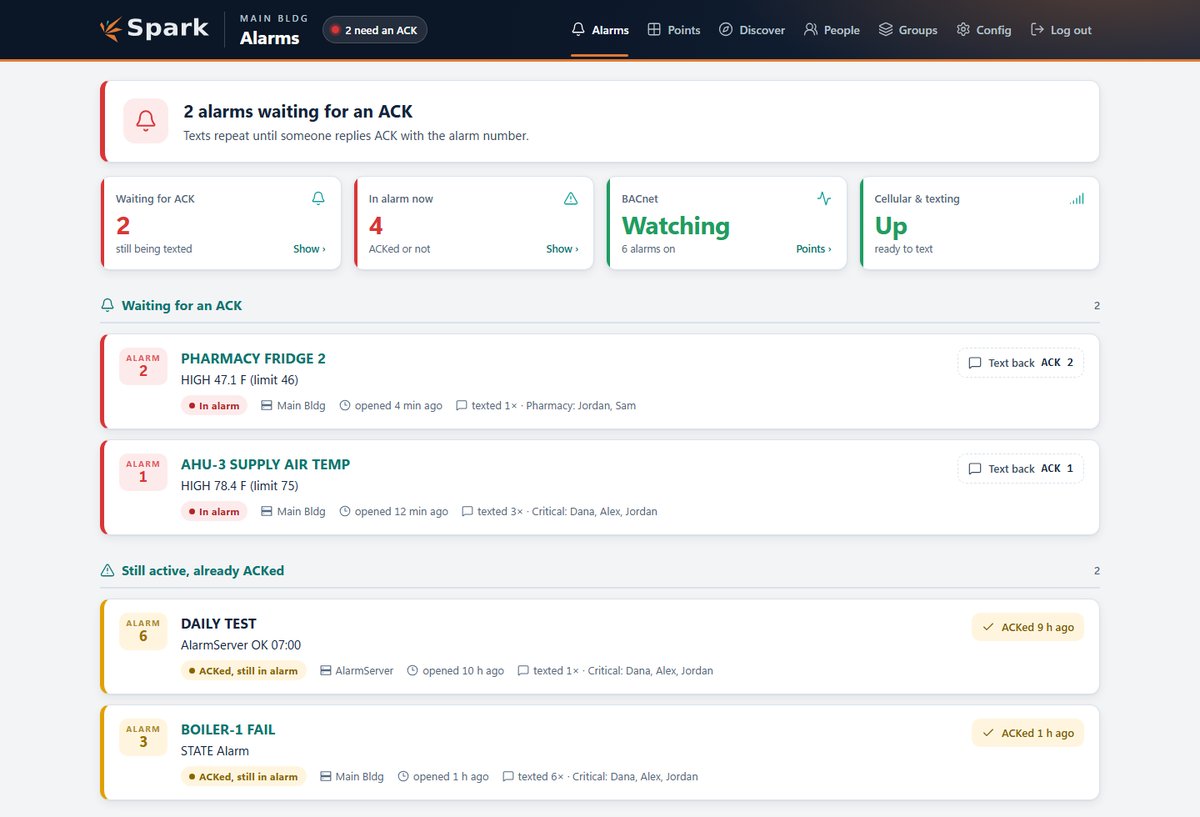
The Alarms page. Example data.
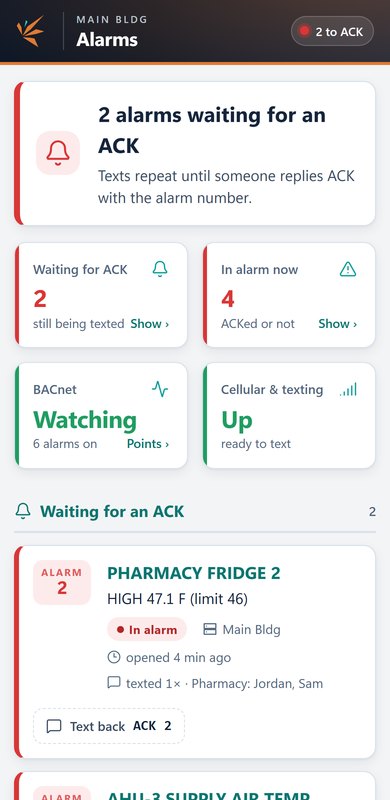
The same page on a phone.
BACnet alarms to your phone, any brand of controls.
Spark talks BACnet/IP and watches points itself, so it does not depend on how a manufacturer set up its own alarming, or on one brand's front end being open and watched.
- BACnet/IP, with routed networks and MS/TP devices behind routers
- Foreign-device registration with a BBMD for controllers on other subnets
- Watches by change-of-value with regular confirming reads, and alarms when a point goes silent
- Read-only toward your controllers: it never writes a value
- Field-tested so far on Reliable Controls; other manufacturers are being tested
Your service, with your name on it.
Spark is sold through and installed by controls contractors. Your logo, company name and service phone appear on the login page and at the foot of every screen, so the building knows who looks after it.
Straightforward to install
Connect it to the BACnet network, pick the points, add the people. No changes to the controllers' programs.
Branded for you
Upload your logo and add your service number on the Config page. Spark's own mark stays small and in the corner.
Something to stand behind
A unit that tests itself every day and says plainly when something is wrong is a unit you can put your name on.
Straight answers.
Does Spark need the internet?
Not to watch your controllers: that happens on the building's own network. Alarm texts go out over Spark's own cellular connection. If that link goes down, Spark says so on its screen and tries to recover it.
Will it change anything in my controllers?
No. Spark only reads values and asks controllers to report changes. It never writes to them.
Is a text guaranteed to arrive?
No one can promise that: texts depend on the cellular network and on the phone. What Spark does is keep texting until someone replies, send a test alarm every morning, and tell you when its own link is down.
Does it use AI?
Not in the alarm path. Watching, deciding and texting follow fixed rules you can read on the screen.
Which cellular carriers does it work with?
The cellular hardware and carrier approvals are being finalized for the first release. Ask us about your area.
What does it cost?
Spark is getting ready for its first pilots with controls contractors. Prices come after the pilots.
Put Spark in one of your buildings.
We're lining up a small number of controls contractors for the first installations.